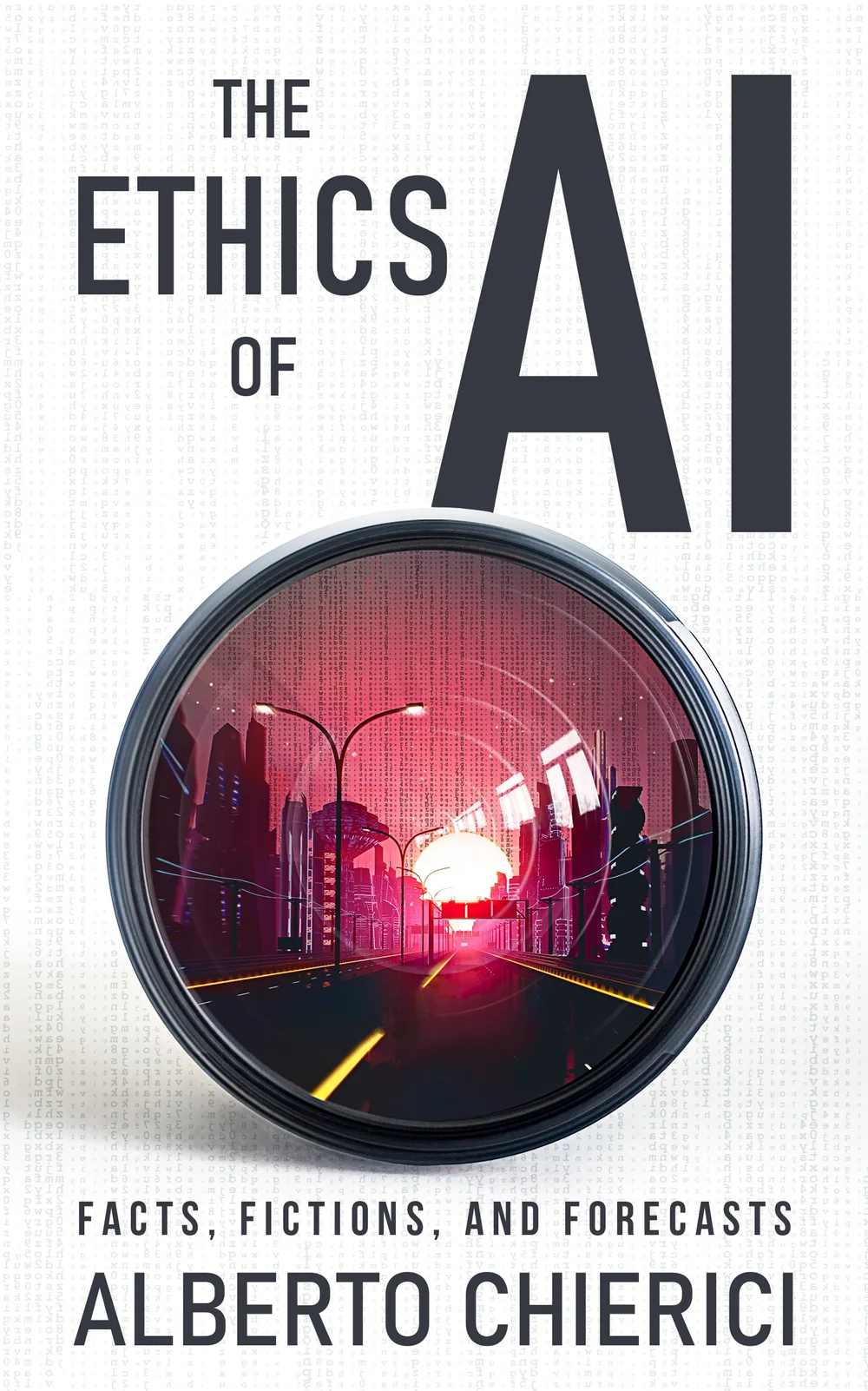
The Ethics of AI: Facts, Fictions and Forecasts explores the questions technologists keep dodging: who decides what's true, what's fair, and what AI should be allowed to do with that power. It brings in the research of moral philosopher and author Jonathan Haidt, former Cambridge Analytica psychology lead Patrick Fagan, and Charles Radclyffe, founder and CEO of the first ESG/Ethical AI rating agency — alongside Alberto's own ten-plus years in data science, building and advising AI-driven companies.
This isn't a book about whether AI will take over the world. It's about the much harder, much more immediate question: how do you make moral decisions in a business built on algorithms, when the people asking you to automate rarely stop to ask whether they should.
Published August 2021. ISBN 1636763650.
I've spent more than ten years working in data science and solving problems at the cross-section of math, algorithmic decision making, economics, and behavioral science. I've built two companies and helped other entrepreneurs build theirs. These experiences have taught me what it takes to build a business from the ground up and shown me the challenges of trying to make moral decisions in challenging situations.
I felt compelled to write to let these experiences shed an original light on understanding AI and the social, ethical, and cultural implications this technology is already generating. Everyone can start doing two things right now: get educated and open up a respectful, inclusive conversation about morality, truth, and our values.
Call me naive, but I believe that, deep down, we all know right from wrong.
You see, I was taught early on that everyone has a conscience, or inner voice, that helps give them the strength to make tough decisions. This inner voice is the primary source of critical thinking. Sometimes we give it up because of external forces like complacency, fear, or merely a little bit of laziness. It requires discipline, and sometimes hard work, to keep listening to that inner voice. With this book, I want to encourage readers to think critically about reality by providing education first and foremost.
I started my career working as an actuary in London. Actuaries are very similar to modern data scientists. They use statistical models, computer programming, and business skills to predict future outcomes, such as the likelihood of a car crash and how much it's going to cost. The same types of techniques drive prices of health insurance, pension funds, investment plans, and life insurance. So, the step between mathematics to real-world societal impact is quite small when you look at it.
Working as an actuary enabled me to pursue a lifelong enthusiasm for exploring the intersection of economics, risk management, and math. It wasn't long before my career path took a natural turn and landed me in the field of data science. In 2013, I started self-teaching machine learning (ML) and artificial intelligence (AI), the bread-and-butter techniques data scientists use to turn data into useful insights and predictions. The more I learned about such tools, the more I found it entertaining to hear the media narratives on AI and ML. I participated in many conferences during my consulting years, and I was invited to give talks when I started my first company. I was disturbed by some of the questions I was asked. For instance, will AI take over the world? When will AI become more intelligent than humans?
These fears have been perpetuated for the past several decades, leading to sensational and often misleading news headlines like "Alibaba and Microsoft AI Beat Humans in Stanford Reading Test" (Lucas, 2018) and "Artificially Intelligent Painters Invent New Styles of Art" (Baraniuk, 2017). Such publications, seemingly ripped from the pages of a science fiction novel, show how little we understand about artificial intelligence. By the way, this technology isn't even that new. In the late nineties — the period of time known as the 'cold winter of AI' because reality deflated the hype generated by the first commercial applications of AI — you could still read articles like "Could a Computer Think like a Human?": the catchy headline of a 1997 opinion piece published in The Irish Times.
The leaders of the AI industry and academic research don't exactly help solve this problem, either. Many of them do an excellent job identifying the issues and potential threats AI poses, but they often fail to address these concerns, instead advocating for regulation as the only safety net for consumers.
Many technology, science, and business leaders have voiced concerns about AI. High-caliber scientists like Stephen Hawking, once said to the BBC, "The development of full artificial intelligence could spell the end of the human race. . . . It would take off on its own and re-design itself at an ever-increasing rate. Humans, who are limited by slow biological evolution, couldn't compete and would be superseded" (Cellan-Jones, 2014).
An even greater authority in the field — the father of modern computing, Alan Turing — said that "it seems probable that once the machine thinking method had started, it would not take long to outstrip our feeble powers . . . They would be able to converse with each other to sharpen their wits. At some stage, therefore, we should have to expect the machines to take control" (Turing, 1951).
Technology philosopher and artist Gray Scott highlights the dilemmas of the most advocated solution — regulation, in a famous quote attributed to him: "The real question is, when will we draft an artificial intelligence bill of rights? What will that consist of? And who will get to decide that?" (Marr, 2017).
Who has control is a critical question. Do we trust the elites and politicians governing a state or a society enough to make such a decision? Do they have enough understanding of the technology and the real issues at stake? Moreover, it is important to keep the conversation focused on real, practical matters. For example, futurists arguing for an AI bill of rights should first prove that an engineering artifact made up of several lines of code can be considered at the same level of natural right as a human person!
Regulations are certainly part of the solution, but I want to argue that there is more we can start doing right now.
While many leaders from this field have been spinning their wheels, others agree that the sensational fears they are broadcasting to consumers aren't at all the real threat we should be worried about as AI continues to develop. In fact, there are far more troubling things beneath the surface.
The shift of jobs and its societal impact is one example. A pragmatic voice alerting against near-term issues that AI is causing is Andrew Ng, co-founder of Google Brain, Coursera, and recently, Deeplearning.ai. Ng points out, "We have seen AI providing conversation and comfort to the lonely; we have also seen AI engaging in racial discrimination. Yet the biggest harm that AI is likely to do to individuals in the short term is job displacement, as the amount of work we can automate with AI is vastly larger than before. As leaders, it is incumbent on all of us to make sure we are building a world in which every individual has an opportunity to thrive" (Ng, 2016).
In a society that seems to be going inevitably toward automating everything, some point out the need for more human values. AI practitioner Amit Ray, author of Compassionate Artificial Intelligence, calls for leaders who embrace increasing automation and algorithmic decision making to be more compassionate: "As more and more artificial intelligence is entering into the world, more and more emotional intelligence must enter into leadership." (Ray, 2018).
One more troubling field is marketing. Learning how professional marketers use psychology to influence behavior opened up a profound realization. Most of the ethical concerns and moral dilemmas that AI applications generate aren't anything new. Most applications of AI that create problems concern the same thing that marketing has always done — influencing behavior. Perhaps more troubling is that, with modern advancements to AI, these programs are getting faster, more efficient, and more accurate.
The issues enumerated above reveal what I believe is the critical issue underneath the creation of an ethical framework for AI and its impact on the future of work and society: the problem of truth.
This point is powerfully made in the recent documentary The Social Dilemma, produced by Netflix in 2020. At one point, the film describes how big tech companies profit off of advertising. AI systems power the majority of the algorithms they use for getting people to click more on advertisements: more clicks equals more ad revenue.
In fact, some examples of ethical issues in AI come from the company that embeds AI into everything it does — Google. The company started in 1996, offering its users something truly revolutionary — a search engine that could help them find information better and faster on the internet. Searching is a basic form of a computer science problem that AI techniques solve well enough. It has a simple and practical purpose.
Google was not born with moral dilemmas from the outset. However, once its business model became focused on advertising, engineers started optimizing algorithms for promoting advertisement. This way of making money created new issues on the ethical side. For example, Google-owned YouTube's recommendation algorithms need to increase the time spent viewing in order to grow revenue from advertising.
The algorithms do not account and cannot know whether any information they are pushing to the user's page is true. Their sole objective is to get clicks. That benefits the spread of fake news, which, according to a recent MIT study, spread six times faster on social media than true stories (Dizikes, 2018). As Sandy Parakilas, former operations manager at Uber and product manager at Facebook says in The Social Dilemma, "We've created a system that biases towards false information . . . because that makes companies more money."
The leading voice and narrator of the documentary is Tristan Harris, one of the most vocal activists exposing serious issues caused by technology companies and AI applications. Once described as the "closest thing Silicon Valley has to a conscience," Harris was a Google design ethicist who is now co-founder and president of the Center for Humane Technology (Bosker, 2016). In the documentary, he says, "If we don't agree on what is true, or that there's such a thing as truth, we are toast! This is the problem beneath other problems because if we don't agree on what's true, then we can't navigate out of any of our problems."
I believe with that sentence, Harris touches a nerve of today's society.
The view of the human person as a mere consumer is perhaps a consequence of the philosophy of relativism, or "the view that truth and falsity, right and wrong, standards of reasoning, and procedures of justification are products of differing conventions and frameworks of assessment and that their authority is confined to the context giving rise to them" (Stanford Encyclopedia of Philosophy).
Simply put, people struggle to agree on how to discern right from wrong.
A modern voice that often addresses moral relativism is Pope Francis. His words in Laudato Si' help highlight the connection between relativism and the exploitation of modern technology (like AI), which treats human beings as mere profit generators: "When human beings place themselves at the center, they give absolute priority to immediate convenience and all else becomes relative. Hence we should not be surprised to find, in conjunction with the omnipresent technocratic paradigm and the cult of unlimited human power, the rise of a relativism which sees everything as irrelevant unless it serves one's own immediate interests. There is a logic in all this whereby different attitudes can feed on one another, leading to environmental degradation and social decay" (Francis, 2015).
It is important to be realistic when we say artificial intelligence can do X, Y, and Z. Then we shall have the courage to question our beliefs and assumptions deep down: Do we espouse the view that the human person is merely someone through which we create profit? What is the human person, and what is the best way to address the needs of a customer, a child, a parent, a free citizen?
I want to dedicate this book to business leaders and professionals eager for answers, those driving AI adoption at their companies, and the engineers who develop AI solutions for helping them find their inner voice.
While many resources work in silos, this is the first work that links AI education and digestible technical content with psychology, case studies, moral dilemmas, philosophy, and a compass for your own critical thinking.
If you picked up this book, you have a desire to learn. You are looking for original thinking that you can leverage for ethical decision making in your job and in your personal life. You will read about what AI really is, how it is connected with behavioral change, forces that move social trends, and the broader economy.
Artificial Intelligence is a fantastic technology. Many of its promises might be a bit too inflated, but it indeed has the potential to create new opportunities. Armed with education and a commitment to addressing deep questions about truth and meaning, we can decide what products, services, and governance model we shall build for serving the person as a whole, rather than treating people like machines. As with any stepping stone of human progress, this allows us to step back and reflect on what kind of future we want to build.